Confidence & Certainty
Consistent measurement
Works with existing tools
What Is UC2?
Uniform Confidence/Certainty Estimation (UC2) is a structured method for measuring and expressing how trustworthy a risk estimate is — not just what the estimate says.
Confidence
How close an estimate is likely to be to the actual truth.
Certainty
How consistently multiple estimates agree with each other.
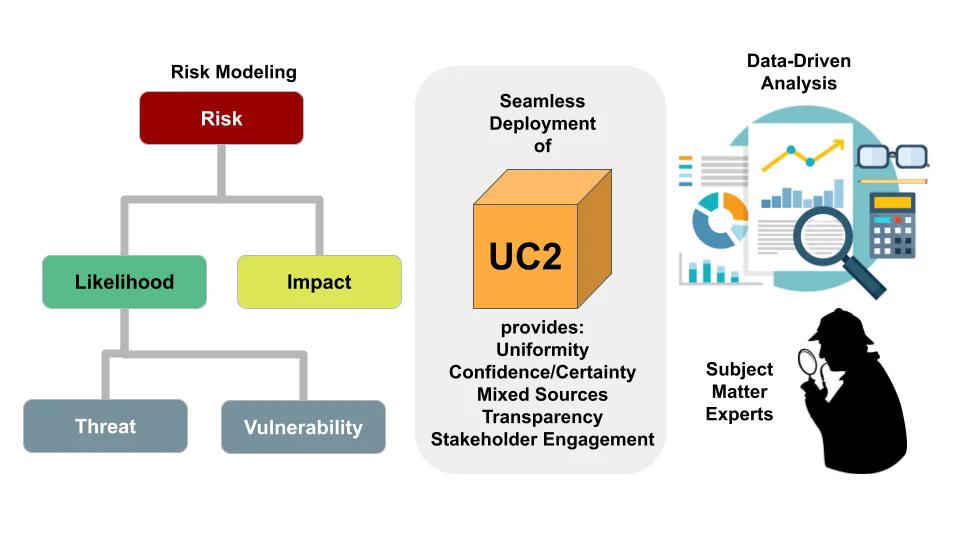
UC2 provides a uniform, consistent scale for both quantitative and qualitative risk inputs, whether they come from hard data, expert judgment, or both. This makes it easier to combine different types of estimates without distortion.
Why UC2 Matters in Risk Management
In most risk processes, analysts face two big challenges:
Challenge #1
Subjectivity and inconsistency in expert estimates
Challenge #2
Difficulty combining data-driven results with expert judgment reliably
Traditional risk scales and matrices often fail to express how much you should trust an estimate, leading to overconfidence, miscommunication, and poorly supported decisions. UC2 fixes this by explicitly capturing both the quality and agreement of risk estimates.
Greater Transparency
Everyone understands not just the risk value but how reliable it is
Improved Uniformity
Numeric and expert-based inputs can be compared on the same terms
Better Engagement
Outputs are clearer and easier to discuss with stakeholders
Who Benefits from UC2?
Risk Analysts and Modelers
Who need consistent inputs into risk equations and models.
Decision-Makers & Stakeholders
Who want clarity about the reliability of risk insights.
Cross-Functional Teams
Combining data analysts, subject matter experts, and leadership.
High-Stakes Organizations
Managing cybersecurity, infrastructure, finance, and operations risk.
Practical Use Cases
1. Blending Data and Expert Judgment
Suppose your risk model uses both historical incident data and expert estimates about future threats. UC2 provides a standardized way to express how confident the experts are and how much the data agrees with them, making combined outputs more defensible and actionable.
2. Improving Risk Workshops
In facilitated risk sessions, participants often provide qualitative judgments like "likely," "unlikely," or "high impact." UC2 lets you place those judgments on a consistent confidence scale, improving group understanding and reducing ambiguity.
3. Integrating with Existing Tools
UC2 can feed directly into existing risk models without replacing them. Its outputs are compatible with common risk quantification formats — such as probability distributions, PERT estimates, or expert scorecards — making adoption incremental and low-disruption.
UC2 for CVSS Presentation
Watch this presentation to see how UC2 enhances vulnerability scoring
UC2 Tools & Applications
UC2 Risk Ruler
Simplify and enhance risk estimation by integrating both quantitative and qualitative assessments from subject matter experts.
Learn MoreCVSS Visualization
Visualize Precision, Maturity, and Confidence in the Common Vulnerability Scoring System to better communicate cybersecurity risk.
Learn MoreIn Summary
UC2 is a practical, intuitive, and compatible approach for strengthening risk estimation by making confidence and certainty explicit.
Combine different sources of risk estimates coherently
Communicate the trustworthiness of estimates
Support better, more transparent risk decisions
By integrating UC2 into your risk workflow, you improve clarity, consistency, and confidence in your risk outcomes — without ripping and replacing your existing models.
Want to Learn More?
Contact us to discuss how UC2 can improve your organization's risk management capabilities.
UC2 transforms how organizations understand and communicate risk — making uncertainty explicit, measurable, and actionable.